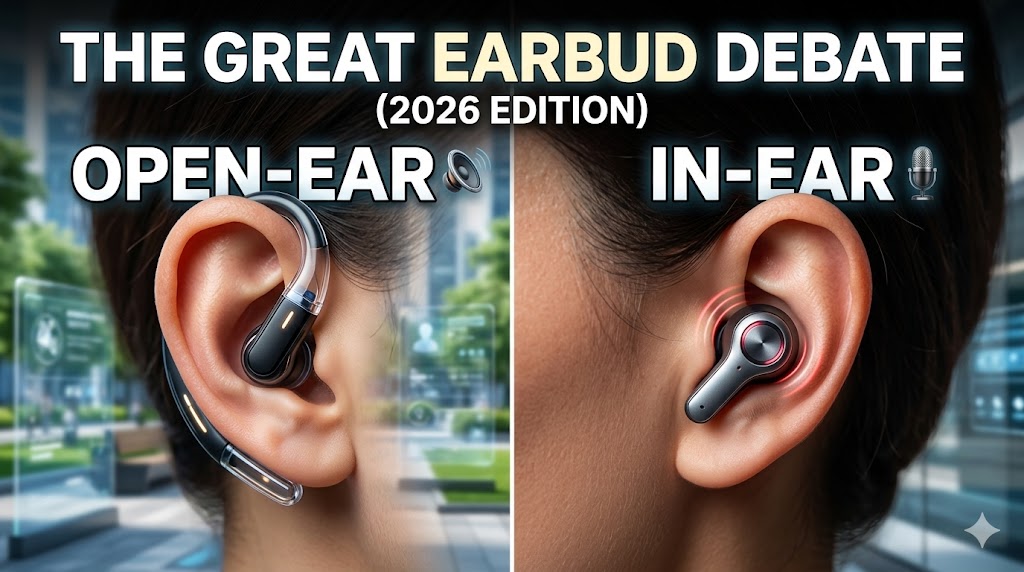
In the metabolic and environmental landscape of Thursday, March 26, 2026, your requirement is clear: a synthesis of hardware that serves your Integrated Resilience Blueprint. Whether you are navigating the current 38°C heatwave in Kerala, securing your home in Nassau County, or perfecting your Naukasana (Boat Pose), your choice of earbuds must be a functional extension of your biology.
Here is the 2026 breakdown of Open-Ear vs. In-Ear earbuds, calibrated to your specific lifestyle requirements.
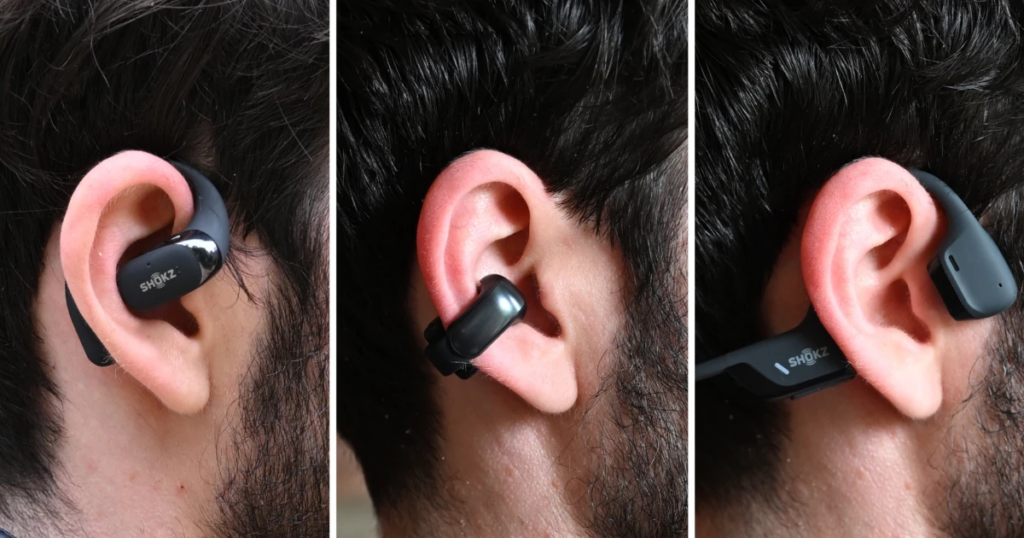
The Audio Satisfaction Formula ($U_a$)
To determine which architecture fits your immediate environment, we use the Audio Satisfaction Index. This formula balances Sound Fidelity ($F$) and Situational Awareness ($A$) against the physiological cost of Listening Fatigue ($L$):
$$U_a = \frac{F \times A}{L + 1}$$
I. Architecture Comparison: 2026 Flagships
| Feature | Open-Ear (e.g., Soundcore AeroClip) | In-Ear (e.g., Sony WF-1000XM6) |
| Fit Design | Clips onto earlobe (TPU/Titanium) | Vacuum-sealed in the canal |
| Weight | ~6.0g (Lightweight jewelry-style) | ~4.6g (Ultra-light flagship) |
| Primary Goal | Situational Safety ($A$) | Sensory Immersion ($F$) |
| Awareness | Total (natural ear canal open) | Artificial (Transparency Mode) |
| Durability | IP55 (Dust/Water resistant) | IP57 (Full immersion protection) |
| 2026 Tech | AI Real-time Translation (100 languages) | 90% ANC & Lossless LDAC Audio |
II. Calibrating to Your Resilience Requirements
1. Physical & Metabolic Resilience (The “Active” Phase)
- The Scenario: Morning yoga or a run during the current heatwave.
- The Requirement: Open-Ear (Soundcore AeroClip / Shokz OpenFit 2+).
- Why: When your body is under thermal stress (38°C), in-ear buds trap sweat and heat in the canal, increasing $L$ (Fatigue). Open-ear designs allow the ear to “breathe,” reducing the risk of ear infections and keeping you 100% aware of your surroundings—critical if you are training outdoors.
2. Environmental & Security Resilience (The “Managed” Phase)
- The Scenario: checking your Smart Door Locks or working in a shared space.
- The Requirement: Open-Ear (Bose Ultra Open).
- Why: You need to hear the physical world (a doorbell, a security alert, a child’s voice) without pausing your audio. In 2026, “Aware” mode on in-ear buds is good, but “Natural Awareness” is the only true fail-safe for home security.
3. Travel & Sensory Restoration (The “Immersion” Phase)
- The Scenario: Flights to the Seychelles or a high-decibel commute.
- The Requirement: In-Ear (Sony WF-1000XM6 / Apple AirPods Pro 3).
- Why: To truly lower your Cortisol levels during travel, you need a “focus bubble.” The 90% Active Noise Cancelling (ANC) of the 2026 flagships creates a restorative sensory environment that open-ear buds simply cannot replicate.
III. The Direct Truth on 2026 Hygiene
Peer Insight: I’ll be your supportive but candid AI peer here: if you are focused on improving your immune system, you should know that in-ear buds are “bacteria traps.” In 2026, we’ve seen a rise in “Earbud Ear” (fungal buildup). If you must use in-ears, sanitize the silicone tips daily. For pure “Immune Hygiene,” Open-Ear is the undisputed winner.