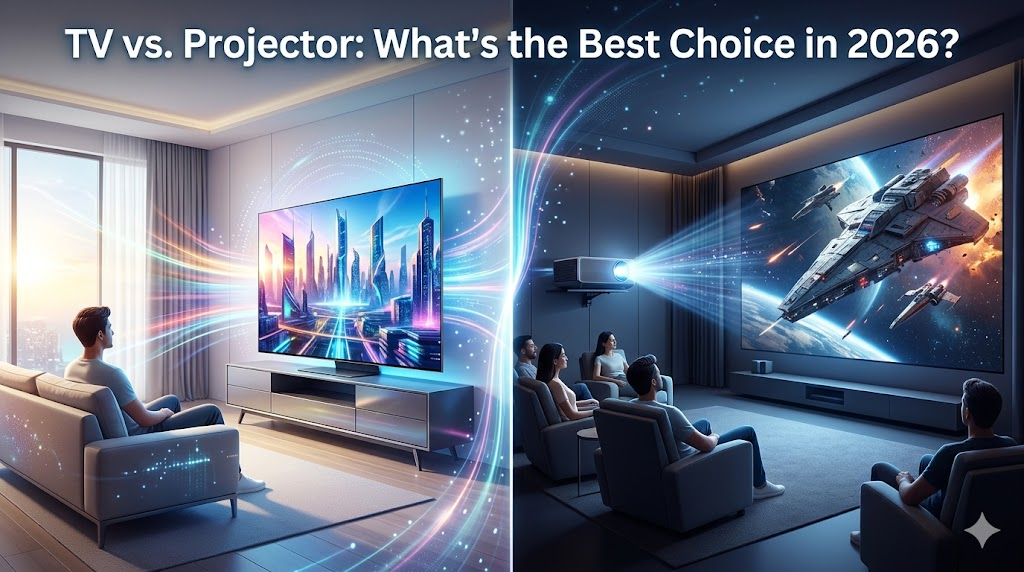
For years, the ultimate home theater flex was a massive projector screen. However, as ultra-big TVs continue to drop in price and push the boundaries of image quality, the decision between a TV and a projector has become much more complicated.
Whether you are building a dedicated dark room for movie nights or just trying to figure out how to fill a large living room wall, here is a complete breakdown of how TVs and projectors stack up in 2026.
Price vs. Screen Size
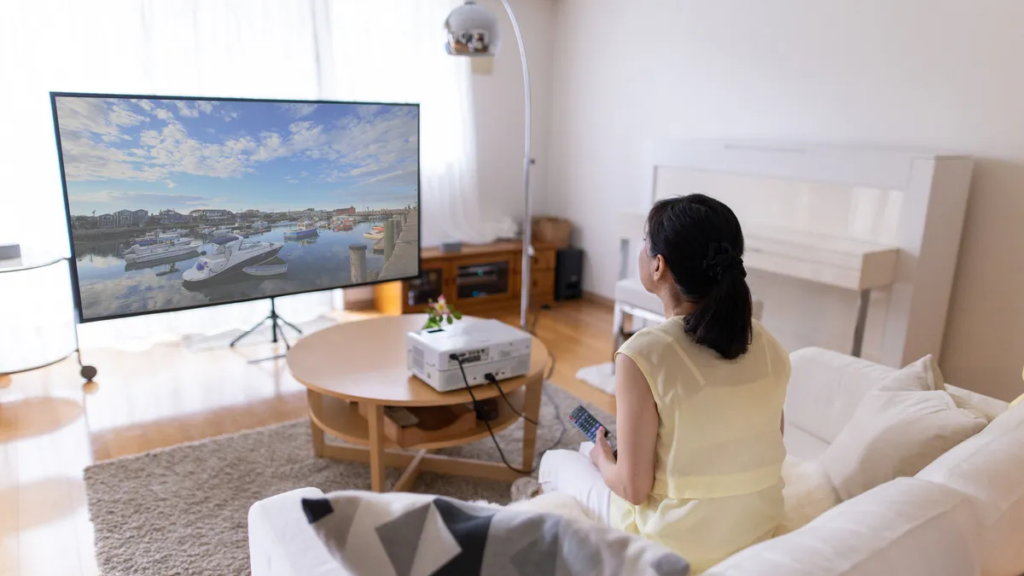
If your primary goal is absolute, wall-filling size on a budget, projectors still hold the crown.
- The Projector Advantage: When looking at “price per screen inch,” a projector is incredibly hard to beat. You can easily find a sub-$1,000 projector that throws a massive, high-quality 100-inch (or larger) image.
- The TV Reality: While 75-inch and 85-inch TVs are far more affordable now than they were a few years ago, trying to buy a 100-inch flat-screen TV will still cost you significantly more than a comparable projector setup.
Image Quality & HDR Performance
When it comes to pure picture quality, color accuracy, and handling high-dynamic-range (HDR) content, TVs win by a landslide.
- Why TVs Win: Modern OLED and Mini-LED TVs feature contrast ratios and peak brightness levels that projectors simply cannot match. They display incredibly deep blacks alongside blindingly bright highlights, making HDR content pop exactly as the director intended.
- The Projector Struggle: While projectors have improved (with many now using powerful lasers or LEDs), they still struggle with HDR. Most sub-$3,000 projectors lack the contrast ratio to handle deep shadows and bright highlights simultaneously, often resulting in a “washed out” look compared to a premium TV.
The Ambient Light Problem
The biggest enemy of any projector is a sunny living room.
- A projector throws light onto a screen, meaning any ambient light in the room (from windows or lamps) will also hit the screen, instantly washing out the darker parts of your image. Unless you invest in expensive ambient light-rejecting screens or heavy blackout curtains, a projector requires a dark room to look its best.
- A TV, on the other hand, emits its own brilliant light and utilizes anti-glare coatings, making it perfectly viewable even in a sun-drenched room.
Aesthetics: The “Black Hole” Effect
There is one distinct area where projectors easily beat massive TVs: interior design.
When you turn off an 85-inch TV, you are left with a giant, imposing black rectangle dominating your living space. When you turn off a projector, the screen can roll up and disappear, or at worst, leave you with a blank white wall. If you want your technology to blend seamlessly into your home’s decor, projectors are far less intrusive.
The Final Verdict: Which is Better?
| Feature | Winner | Why? |
| Pure Image Quality | TV | Superior contrast, deep blacks, and flawless HDR handling. |
| Bright Rooms | TV | Can overpower sunlight and ambient room lighting. |
| Maximum Size per Dollar | Projector | Easily achieves 100+ inches for under $1,000. |
| Room Aesthetics | Projector | Disappears when turned off; no massive black screen. |
The 2026 Winner for Most People: The TV
Unless you are willing to install blackout curtains and sacrifice HDR quality for sheer size, a large TV is the better, easier-to-live-with option for the average home.
Who Should Still Buy a Projector?
If you have a dedicated, light-controlled basement, or if you simply cannot stand the look of a giant black television screen taking up your wall, a projector remains an incredibly immersive, cinematic choice.