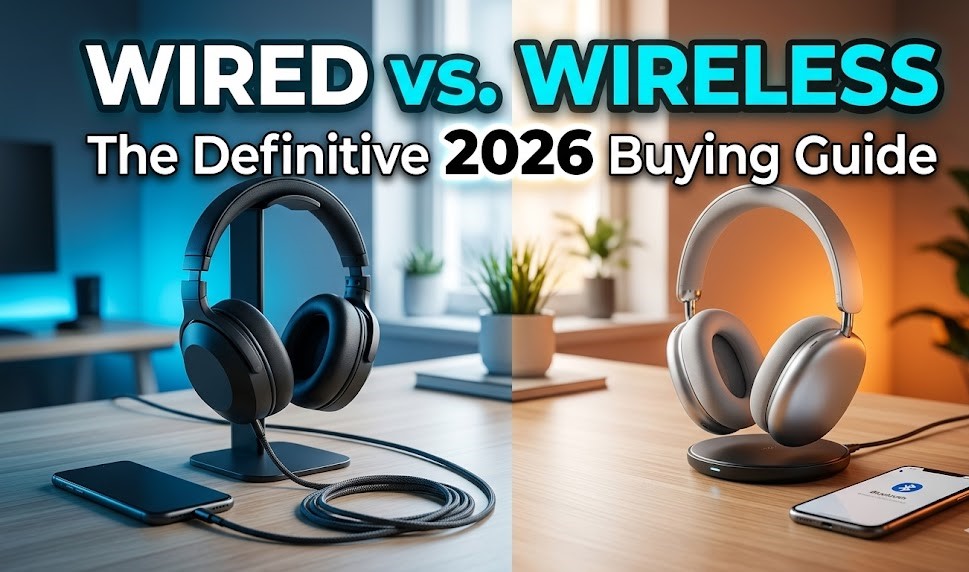
The debate between wired and wireless headphones has shifted dramatically in 2026. While wired connections once held a monopoly on high-fidelity sound, modern wireless connectivity and advanced codecs have leveled the playing field for the average listener. However, the “best” choice still depends heavily on your specific lifestyle—whether you’re dodging traffic on a commute, competing in a high-stakes eSports tournament, or looking for gear that will last a decade.

The Core Technological Difference
The fundamental split lies in how the audio signal travels from your device to your ears:
- Wired Headphones: Receive an analog signal directly via a copper cable. This signal moves a coil and diaphragm to create sound waves. No battery or internal processing is required.
- Wireless Headphones: Receive a digital signal (usually via Bluetooth or 2.4GHz RF). These contain a built-in Digital-to-Analog Converter (DAC), an amplifier, and a battery to process and play the sound.
Comparison at a Glance: Wired vs. Wireless
| Feature | Wired Headphones | Wireless Headphones |
| Primary Advantage | Reliability & Longevity | Convenience & Freedom |
| Sound Quality | Best “bang for buck” | High-res possible via LDAC/aptX |
| Latency | Near Zero ($<1$ms) | $10$ms (RF) to $150$ms+ (Bluetooth) |
| Battery Life | Infinite (No charging) | $20$ to $80$ hours (Requires charging) |
| Durability | High (fewer failure points) | Moderate (battery eventually degrades) |
Key Factors to Consider
1. Sound Quality: Breaking the Myth
Contrary to popular belief, wired does not automatically mean better. Sound quality depends more on driver tuning and file quality. However, for audiophiles, wired remains superior because it avoids the Bluetooth compression found in lower-end wireless models. In 2026, premium wireless cans like the Sony WH-1000XM6 use advanced codecs to deliver audio that is nearly indistinguishable from CD quality.
2. Latency: The Gamer’s Dilemma
For fast-paced gaming or professional video editing, latency (the delay between action and sound) is critical.
- Standard Bluetooth often feels “laggy.”
- 2.4GHz RF Dongles (found in headsets like the Razer BlackShark V3 Pro) reduce this to a negligible $10$–$20$ms.
- Wired remains the safest bet for guaranteed zero-delay performance.
3. Travel and Commuting
Wireless headphones dominate this category. The lack of a physical cable prevents tangles in crowded spaces, and most flagship wireless models feature Active Noise Cancellation (ANC), which is essential for neutralizing plane engines or metro screeching.
Professional Tips for Longevity & Health
Regardless of your choice, maintaining your gear is vital for your health and your wallet:
- Hearing Safety: The Mayo Clinic warns that listening to any headphones at volumes above $85$ decibels for extended periods can lead to permanent noise-induced hearing loss.
- Sustainability: If you are environmentally conscious, wired is the clear winner. Wireless headphones rely on lithium-ion batteries that eventually lose their ability to hold a charge, often leading to the entire unit being discarded.
- The Hybrid Solution: Look for “Hybrid” headphones like the Fairphone Fairbuds XL, which support both Bluetooth and wired modes and feature replaceable parts to combat e-waste.
Conclusion: Which Should You Buy?
Most people should buy wireless headphones for the sheer convenience and integration with modern smartphones. However, you should stick to wired headphones if you are a professional gamer, a dedicated audiophile on a budget, or someone who values a “buy it for life” philosophy.