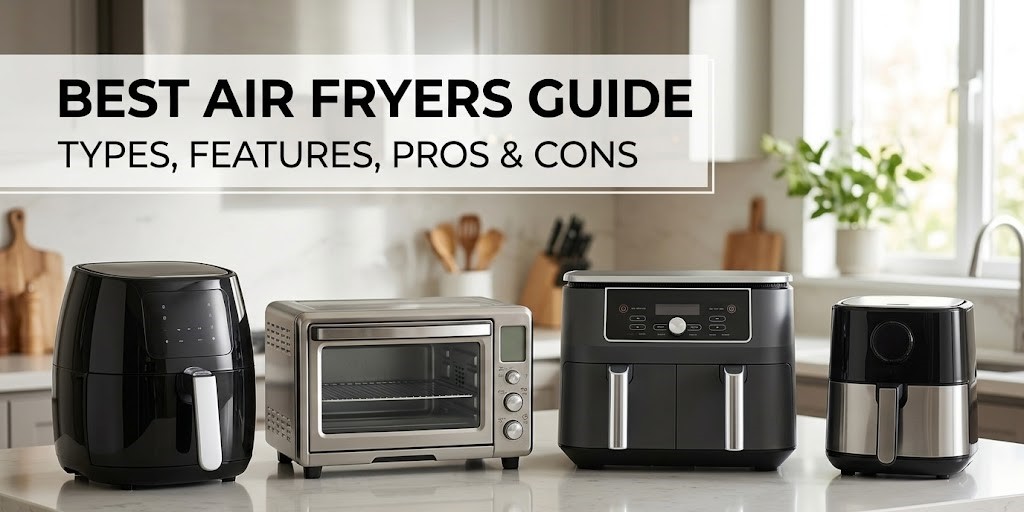
Air fryers have revolutionized modern kitchens. Unlike traditional deep fryers that submerge food in boiling oil, these appliances are essentially highly concentrated countertop Convection ovens. They utilize a mechanical fan to circulate hot air rapidly around the food, producing a crispy, browned exterior via the Maillard reaction with a fraction of the oil.
With a massive surge in popularity, the market is now flooded with various styles. Choosing the best one depends entirely on your household size, counter space, and culinary habits. Here is a comprehensive breakdown of the eight primary types of air fryers to help you make an informed decision.
The Standard Models
These are the foundational designs that popularized the appliance.
1. Basket-Style Air Fryers
The original and most ubiquitous design. It features a simple pull-out drawer containing a nonstick basket.
- Key Features: Compact footprint, simple digital or analog controls, and typically ranges from 2 to 6 quarts in capacity.
- Pros: Highly affordable, incredibly easy to use, and heats up faster than a traditional oven. Perfect for fries, wings, and reheating leftovers.
- Cons: Limited cooking space. You cannot cook multiple dishes simultaneously, and you must manually pause the cycle to shake or flip the food for even browning.
2. Compact / Mini Air Fryers
Miniaturized versions of the basket-style, designed for extreme space efficiency.
- Key Features: Very small capacity (1 to 2 quarts), highly portable, and extremely lightweight.
- Pros: Ideal for college dorms, single-person households, or tiny apartment kitchens. Highly energy-efficient for small, quick snacks.
- Cons: Severely limited functionality. Cannot cook full meals or large cuts of meat.
3. Large-Capacity / XL Family Air Fryers
Scaled-up basket models designed to handle bulk cooking.
- Key Features: Massive capacity (6 to 10+ quarts), capable of fitting whole chickens or large, family-sized batches of fries.
- Pros: Drastically reduces cooking time by eliminating the need for multiple batches. Excellent for meal-prepping or large families.
- Cons: Requires significant, permanent counter space and consumes more electricity than standard models.
Advanced and Multi-Functional Models
If you want an appliance that does more than just fry potatoes, these hybrid machines offer vast culinary versatility.
4. Dual-Basket Air Fryers
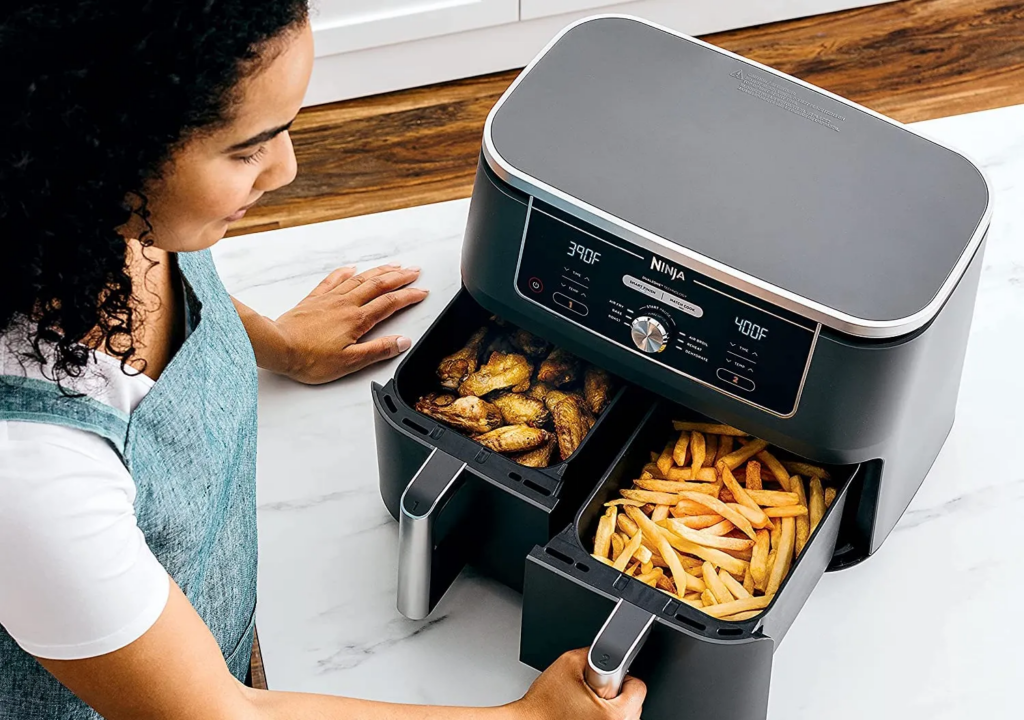
A relatively new innovation featuring two entirely independent cooking zones side-by-side.
- Key Features: Two separate baskets (usually 4 to 6 quarts each) with independent temperature and timer controls, plus “smart sync” technology.
- Pros: You can cook salmon at 400°F in one basket and asparagus at 350°F in the other, and the machine will sync the finish times so both dishes are hot and ready simultaneously.
- Cons: Extremely bulky and generally more expensive than single-basket options.
5. Oven-Style (Toaster Oven) Air Fryers
These resemble traditional countertop toaster ovens but are equipped with high-powered convection fans.
- Key Features: Large capacity (10 to 25 quarts) featuring multiple wire racks, a transparent viewing door, and often a rotisserie spit.
- Pros: Incredible versatility. They can toast bread, bake a 12-inch pizza, broil fish, and air fry simultaneously across multiple levels. Great for entertaining.
- Cons: The largest footprint of all types. They also tend to take slightly longer to preheat than tightly enclosed basket fryers.
6. Multi-Cooker Air Fryers (Pressure Cooker Combos)
These hybrid devices combine the wet heat of a pressure cooker with the dry heat of an air fryer.
- Key Features: Utilizes interchangeable lids (or a hinged lid system) to switch between pressure cooking, slow cooking, steaming, and air frying.
- Pros: The ultimate space-saver if you want multiple appliances in one. You can pressure-cook a whole chicken to retain moisture, then switch to the air fryer lid to instantly crisp the skin.
- Cons: Very heavy, bulky to store, expensive, and comes with a steeper learning curve to master all the functions.
Specialized and Tech-Driven Models
For consumers looking for automation or smart home integration.
7. Paddle-Type (Self-Stirring) Air Fryers
Designed to eliminate the need to manually shake the basket.
- Key Features: Features a slow-moving, motorized paddle inside the cooking chamber that continuously turns the food.
- Pros: True hands-free cooking. Guarantees perfectly even browning for small items like fries or stir-fry vegetables.
- Cons: More expensive, limited availability in the US market, and the paddle mechanism makes it impossible to cook larger, solid items (like steaks or fish fillets) without destroying them.
8. Smart Air Fryers (Wi-Fi & App Control)
Standard basket or oven models equipped with internet connectivity.
- Key Features: Connects to smartphone apps and integrates with smart home assistants like Amazon Alexa or Google Home.
- Pros: Allows you to monitor cooking progress from the couch, receive push notifications when food is done, and send exact temperature/time presets directly from an online recipe to the machine.
- Cons: Commands a premium price tag for features that many casual users may find unnecessary.