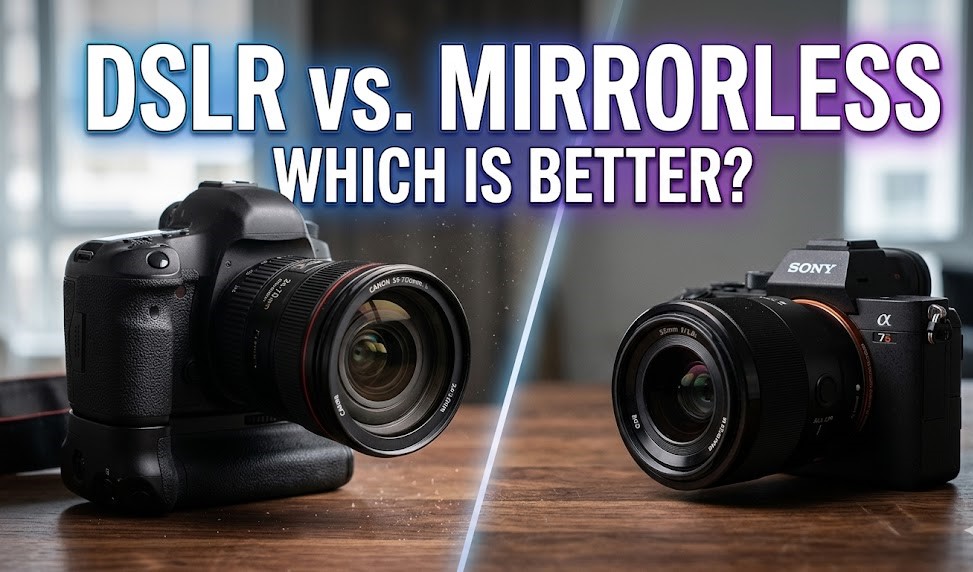
Whether you are upgrading from an older camera or stepping up from a compact point-and-shoot, the choice between a traditional Digital single-lens reflex camera (DSLR) and a modern Mirrorless interchangeable-lens camera is one of the most important decisions you will make. While DSLRs have set the benchmark for years, mirrorless systems represent a massive step forward in performance and creative possibilities.
Here is a breakdown of the key differences to help you make the right choice for your photography and video needs.
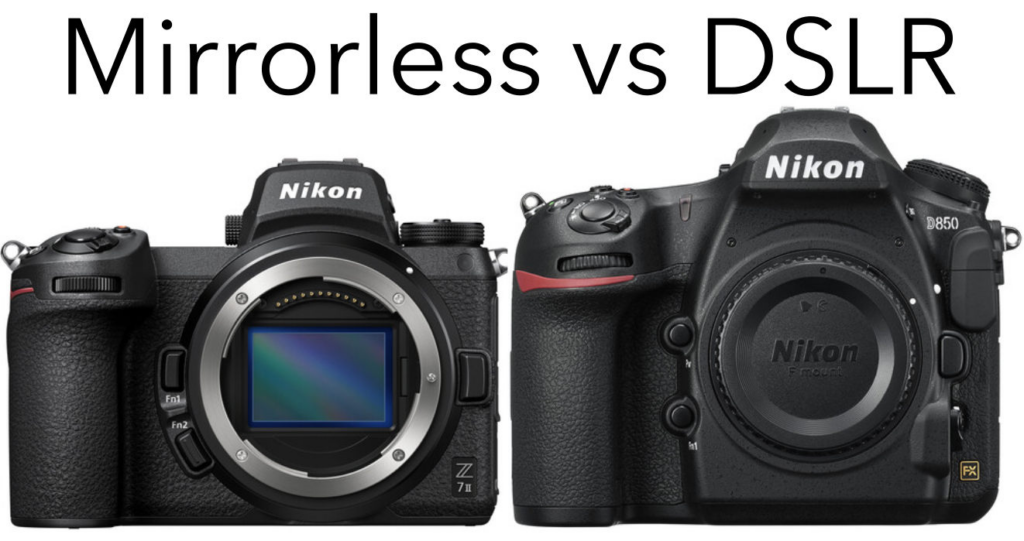
Body Size and Weight
The term “DSLR” refers to the reflex mirror inside the camera that reflects light up into the viewfinder. When you press the shutter, this bulky mechanism must flip out of the way to expose the sensor. Mirrorless cameras completely remove this mechanism.
- Portability: Eliminating the mirror box drastically reduces the size and weight of the camera body. For example, a mirrorless Canon EOS R8 setup is over 34% lighter than a comparable DSLR equivalent.
- Better Lens Design: Removing the mirror allows the lens mount to sit much closer to the sensor. This structural advantage enhances optical performance, improves communication speed between the camera and lens, and paves the way for groundbreaking new lens designs.
The Viewfinder Experience
DSLRs utilize an optical viewfinder, which provides a clear view of the scene but prevents you from previewing your image settings before taking the shot. Mirrorless cameras utilize an Electronic viewfinder (EVF).
- Exposure Simulation: What you see in the EVF is a direct digital projection of the sensor image. You can see exactly how your exposure, white balance, and picture styles will look before you even press the shutter.
- Low-Light Visibility: The EVF allows you to clearly compose and focus your shot even in dark conditions where an optical viewfinder would appear pitch black to the naked eye.
- Digital Aids: Mirrorless viewfinders offer real-time assistive overlays like focus peaking and zebra patterns, which are especially useful for shooting video.
“The EVF on mirrorless cameras gives you the ability to see the exposure of the image before you’ve even taken it.” — Mike Burnhill, Canon Europe Senior Product Specialist
Speed, Autofocus, and Image Quality
The digital architecture of mirrorless cameras elevates both speed and precision to entirely new levels.
- Advanced Autofocus: Mirrorless cameras use the imaging sensor itself for focusing. This allows you to select an Autofocus point anywhere in the frame, rather than relying on a cluster of points in the center like a DSLR.
- Intelligent Tracking: Modern mirrorless systems feature advanced AI tracking that automatically locks onto the eyes of humans, animals, and even fast-moving vehicles.
- Blistering Speeds: Without a physical mirror to move, mirrorless cameras can shoot at incredible continuous frame rates using an electronic shutter (up to 30fps on select models).
- Image Stabilization: Many mirrorless bodies feature a 5-axis In-Body Image Stabilizer (IBIS). When paired with a stabilized lens, this system can counteract extreme camera shake, allowing for sharp handheld shots at very slow shutter speeds.
Electronic Shutters and Battery Life
- Silent Shooting: An electronic shutter allows you to shoot completely silently. This is absolutely invaluable when photographing nervous wildlife or capturing quiet moments at a wedding.
- Battery Performance: It is often said DSLRs have better battery life because their optical viewfinders consume zero power. While this is true for viewfinder-only shooting, mirrorless cameras are typically more power-efficient if you frequently use the rear LCD screen to compose and review your shots.