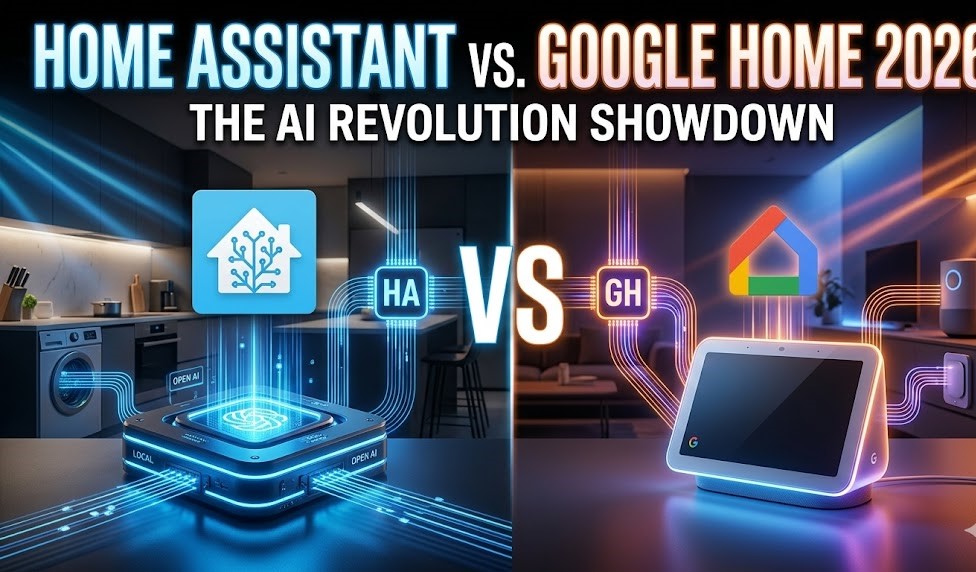
The smart home landscape of 2026 is no longer defined by simple “on/off” switches; we have officially entered the era of the Proactive AI Agent. While Google has spent the last year “Gemini-fying” its entire ecosystem to offer human-like conversation, Home Assistant has doubled down on its “Year of Voice,” bringing local, private Large Language Models (LLMs) to the edge.
Choosing between them in 2026 is a choice between convenience-driven intelligence and privacy-first autonomy. It’s the difference between a home that talks to Google and a home that talks to you.
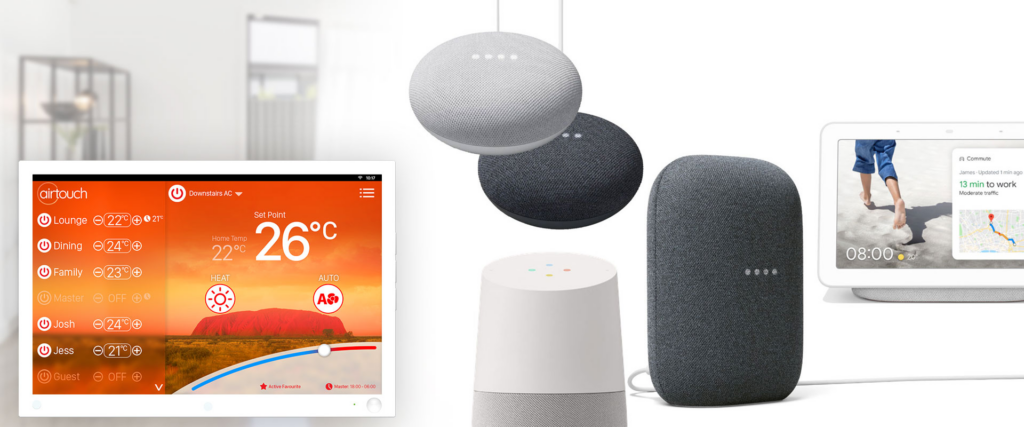
2026 Platform Comparison Matrix
| Feature | Home Assistant (2026) | Google Home (2026) |
| Assistant Type | Local-First AI (Assist / Open LLMs) | Gemini for Home (Cloud-Native) |
| Matter Version | Full Matter 1.4+ Support | Full Matter 1.4+ Support |
| Subscription | Nabu Casa: €7.50/mo (Optional) | Google Home Premium: €10–20/mo |
| Hardware Cost | HA Green: ~€139 | Nest Hub Max: ~€229 |
| Automation | YAML, Blueprint, Node-RED | “Help Me Create” (Gen-AI Prompting) |
| Data Privacy | 100% Local (Encrypted) | Cloud-Logged (Gemini Training) |
| Offline Ability | Full functionality without internet | Critical routines only (Matter/Thread) |
01. The AI Factor: Gemini vs. Local LLMs
Google Home: The “Gemini” Era
Google has officially retired the “Assistant” branding in favor of Gemini for Home. This is a total reimagining of the domestic space:
- Ask Home: You can now ask complex, contextual questions like, “Hey Google, did the kids get home from school?” Gemini will analyze your Nest Cam history and provide a summary.
- Help Me Create: Using natural language, you can build automations: “If the Pixel Tablet isn’t docked by 9 PM, notify me.” * Gemini Live: On Nest speakers, you can have back-and-forth brainstorming sessions without using “Hey Google” every time. Explore the latest Google Nest AI updates for a deeper look at these features.
Home Assistant: The Privacy-First Brain
Home Assistant’s response to Gemini is its Local Voice Architecture.
- Local LLMs: Many users are now running pruned models (like Llama 3 variants) directly on their Home Assistant Green hardware.
- Assist: Unlike Gemini, HA’s “Assist” doesn’t need to send your “Goodnight” routine to a server in Virginia. It processes the intent locally in milliseconds using the logic:If (Time>22:00) ∩ (Phone_Charging)⟹(Activate_Scene.Sleep)
02. Connectivity: Matter 1.4 and Energy Management
By March 2026, Matter 1.4 has become the baseline. This version introduced critical support for:
- Energy Management: You can now natively integrate solar panels and EV chargers. For technical specifications on cross-platform compatibility, check the Connectivity Standards Alliance (CSA).
- Enhanced Multi-Admin: Sharing a Matter lock between Google and Home Assistant is now a one-tap process.
- Thread Border Routers: Google Nest Wifi Pro acts as a high-speed Thread Border Router, but Home Assistant remains superior for managing the “Thread Network Graph” to troubleshoot dead zones.
03. The Cost of Intelligence: Subscriptions in 2026
The price of smart home management has risen due to the high cost of AI computing power.
- Google Home Premium (Rebranded from Nest Aware):
- Standard (€10/mo): 30 days of event history and AI automations.
- Advanced (€20/mo): 60 days of history and “Live Search” capabilities.
- Nabu Casa (Home Assistant Cloud):
- Cost (€7.50/mo): This supports the open-source project and provides easy remote access. It remains entirely optional, as advanced users can set up remote access via VPN/Tailscale for free. More info is available at Nabu Casa Pricing.
04. Automations: Power vs. Ease
The “Automation Gap” is closing, but a winner remains for complexity.
- Google Home: Now excels at Natural Language Automations. If you can say it, Google can (usually) build it.
- Home Assistant: Remains the king of Deterministic Automation. The UI is friendlier than ever, but the real power lies in Node-RED and Jinja2 templating, allowing for a home that feels truly sentient.
Conclusion
In 2026, the choice is no longer about which platform supports your lightbulbs—Matter has mostly solved that. The choice is about who you trust with your data.
Choose Google Home if you want a “magical” experience where you can talk to your house like a person and have it build routines for you instantly. It is perfect for families prioritizing convenience.
Choose Home Assistant if you want a “future-proof” fortress. It requires a bigger initial investment in hardware, but the reward is a home that works 100% offline, protects your data from “AI training,” and offers levels of customization that commercial platforms simply cannot match. In the battle of local vs. cloud, the winner is whichever one makes you feel most at home.