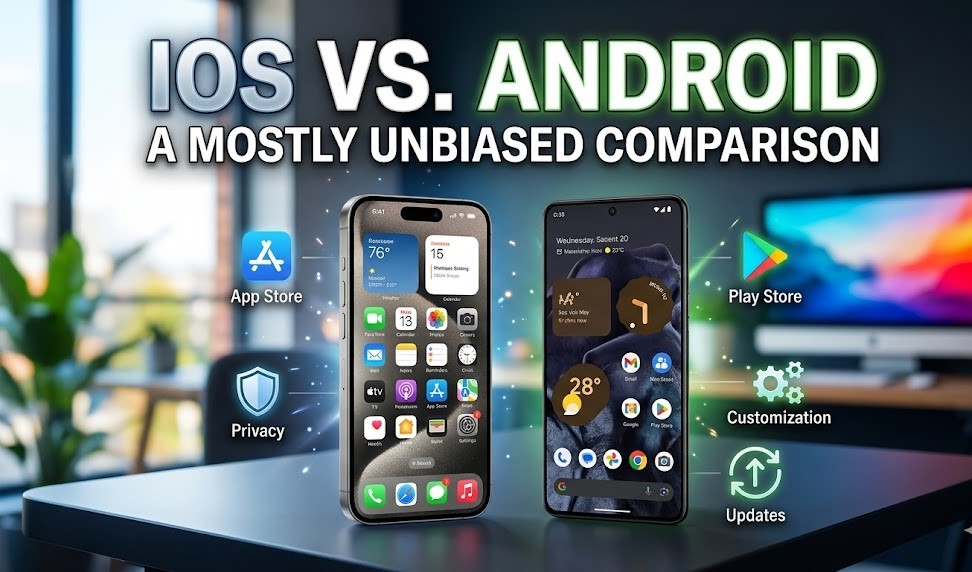
My first phone was a Samsung Galaxy S3, and I later upgraded through the generations with Samsung’s S7 and S10 models. I was generally quite happy with the devices. In fact, I was convinced that Android (operating system) was superior to iOS, with its customizability, sideloading options, and OLED screens.
However, there were always those around me who thought differently and made sure to let me know. In recent years, Apple has addressed some of my major gripes with their offerings. Plus, I now use a MacBook as my primary computer. After spending two years at a university where at least 80% of students use iPhones, I caved in. I decided to rent an iPhone 14 and use it as my daily driver for three months to make an informed decision on which platform I truly prefer.
The Nitpicky Comparison: What I Love About iOS
- OLED Black: I am a huge fan when UIs take full advantage of pure blacks and use a fully black background. iOS does this perfectly as part of its design language.
- Haptic Feedback: Apple is well known for integrating great haptic feedback into their products, and the interactions on iOS were top-notch.
- Back Gesture: Contrary to what many others say, I really liked the way iOS handles going back pages. Pulling a page from the left side of the screen to go back is a great gesture.
- Apple Wallet: The integration of the wallet into iOS makes it feel much smoother. Double-pressing the power button requires you to be very intentional, and you are visually presented with the exact card with which you are about to pay.
- Ecosystem: The experience is excellent when combined with other Apple devices. Clipboard sharing and device switching on AirPods work seamlessly.
What I Don’t Like About iOS
- Insane “Security” Requirements: I don’t have a paid Apple developer account. As a consequence, I wasn’t able to easily install an app that I built on my own device.
- Stock Apps: I am not a huge fan of the iOS stock apps. Apple’s apps remind me very much of Samsung’s stock apps: They do the basics well enough, but there is great room for improvement. The calculator is too basic, and the stock alarm app automatically turns itself off after a while.
- Background Tasks: iOS almost made me fail a university module. When trying to upload video files to Google Drive, iOS ended up killing my upload halfway through. Even worse, when sharing/uploading files to apps like Google Drive, your iPhone becomes useless as the upload dialog completely blocks any interactions.
What I Love About Android
- Link Handling: When clicking some kind of link in an app, very often, you have the choice on an OS level regarding which app you want to open said link in. On iOS, you are stuck with whatever app the linking developer prefers you to use.
- Notifications: I could go on for a long time about how much better notifications are on Android. Inline actions, one-tap suggestions, and OS-level control for priority levels are massive advantages.
- Smart Everyday Helpers: Time and time again, Android and Google impress me with small features that make a difference in your everyday life. The Wallet app automatically detects the flight for a boarding pass and shows you from which gate the flight is leaving.
- Charging Estimator: Only Android gives you a clear visual indication of whether the charger you are using is actually fast-charging your phone or not, and roughly how long it takes until the phone is fully charged.
Conclusion: Returning to Android
iOS and Android have become very similar to each other over the years. Curiously enough, I found iOS to be the platform of extremes. Either something was really well-executed or a big annoyance. Android feels less polished in certain places but handles everything else very reasonably.
I decided to return to Android and pick up a Pixel 8 after my iOS trial. I found the modern stock Android look to be very fun, and it brings me joy every time I use it. iPhones do their job just fine, and I can now very well respect someone’s decision to choose iOS, but I personally prefer the Android way of things—for now.