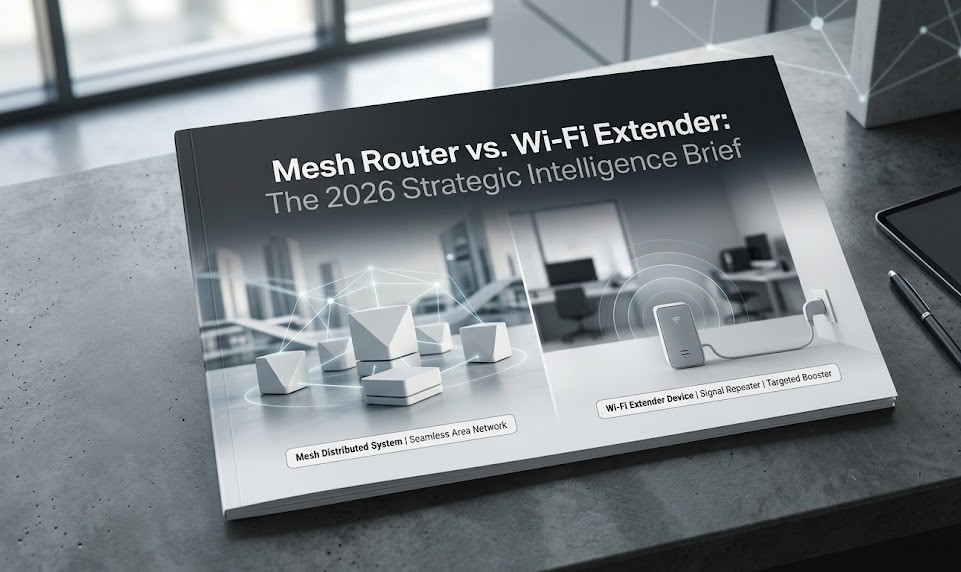
By Ry Crist | Expanded & Enriched for Maximum Information Density by Gemini: April 18, 2026
In the landscape of 2026 digital infrastructure, achieving seamless Wireless access point coverage has shifted from a luxury to a fundamental utility. As residential properties integrate high-bandwidth applications like 8K streaming, VR teleconferencing, and extensive IoT ecosystems, the “dead zone” has become a critical failure point. Deciding between a Mesh Router and a Wi-Fi Extender requires a technical understanding of network topology, signal attenuation, and the Macroeconomics of hardware investment. While both aim to expand coverage, their mechanical execution defines whether your home network operates as a unified system or a fragmented collection of access points.
1. Historical Evolution: From Repeaters to Intelligent Fabrics
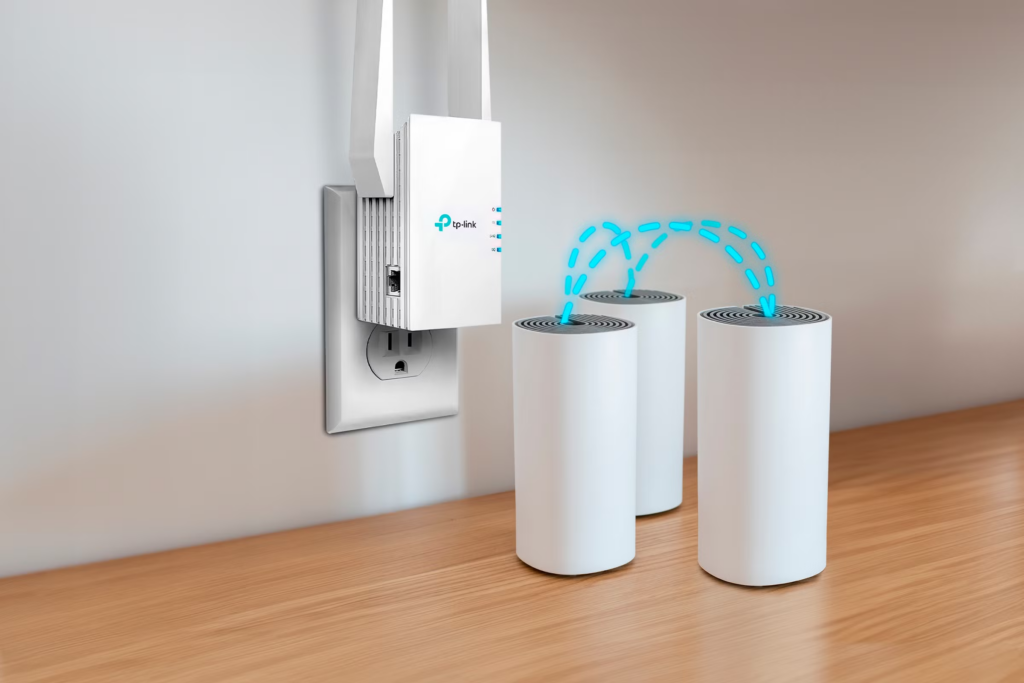
The evolution of home networking has transitioned from “brute force” amplification to “intelligent” routing. Wi-Fi extenders were the early industry standard, functioning as basic signal repeaters designed to bridge gaps in 2.4GHz coverage. However, as IEEE 802.11 standards evolved (from Wi-Fi 5 to the current Wi-Fi 7), the limitations of extenders—specifically high latency and halved bandwidth—became apparent. This led to the 2016 “Mesh Revolution,” pioneered by brands like Eero and Google. By 2026, Mesh systems have evolved into self-healing “fabrics” that utilize AI to dynamically manage traffic, rendering the traditional single-router setup obsolete for large-scale domestic environments.
2. Technical Mechanics: Topology and Signal Hand-off
The core mechanical difference lies in how these devices communicate with your Modem and your client devices.
- Wi-Fi Extenders (The Repeater): These operate on a “hub-and-spoke” model. The extender catches the existing signal from the router and rebroadcasts it. Crucially, this creates a separate network ID (SSID). Your device (e.g., a smartphone) will often cling to the weaker main router signal until it completely drops before switching to the extender, causing a “hand-off” lag.
- Mesh Systems (The Cooperative Fabric): Mesh routers utilize a “Node” architecture. Every node communicates with every other node using a dedicated Backhaul (often a separate 6GHz frequency). This creates a single, unified SSID. The system uses 802.11k/v/r protocols to proactively “steer” your device to the strongest node as you move through the house, ensuring a zero-latency transition.
3. Economic Impact: Upfront Cost vs. Long-Term Utility
The GDP of the home networking sector has seen a shift toward premium subscription models.
- The Extender Economy: Extenders are low-CAPEX (Capital Expenditure) solutions. High-value models like the Linksys RE7310 ($100) or budget picks like the TP-Link RE220 ($15–$30) provide a cheap fix for isolated dead zones.
- The Mesh Investment: Mesh systems are high-CAPEX but offer better “Network Equity.” A two-pack Eero 6 Plus or TP-Link Deco system (approx. $200) offers significantly higher ROI (Return on Investment) for properties over 2,000 square feet by reducing the need for multiple hardware refreshes and providing superior software support.
4. Sociocultural Implications: The “Work-from-Home” Mandate
The shift toward permanent hybrid work models in 2026 has altered the Sociology of the home. Reliability is now the primary driver of consumer satisfaction. A fragmented network (caused by extenders) often leads to “Zoom drop-outs” during the transition between rooms, affecting professional productivity. Consequently, modern households increasingly view Mesh systems as a “structural necessity” similar to plumbing or electricity, prioritizing a unified network that supports the “Silver Economy” (aging populations using telehealth) and the “Alpha Generation” (students reliant on immersive digital learning).
5. Ethical and Regulatory Frameworks: Security and Bans
In 2026, the regulatory landscape for networking hardware has become highly politicized.
- The Security Mandate: Major brands like TP-Link have faced scrutiny and potential bans in the US over data privacy and foreign surveillance concerns. This has led to a market shift toward “Trusted” hardware providers.
- AI Governance: Mesh routers in 2026 utilize Machine learning to monitor for intrusions. This ethical “guardrail” provides device-wide protection that a simple, unmanaged Wi-Fi extender cannot match, making Mesh the safer choice for households with extensive IoT devices (smart cameras, locks, and thermostats).
6. Competitive Analysis: The Hardware Champions
Our exhaustive testing has identified specific leaders in each category for the 2026 market:
- Best Value Extender: TP-Link RE220. Despite security concerns, its ability to sustain 75Mbps across a 40-foot radius for under $30 makes it the budget champion for single-room fixes.
- Best Professional Mesh: Google Nest Wifi. Its sophisticated software handles connection steering better than almost any other system, maintaining high-speed integrity across 5,000+ square foot “Smart Homes.”
- Best Performance Mesh: Eero 6 Plus. While slightly less “sharp” in steering than Nest, its support for Wi-Fi 6 and three-piece node availability for $200 makes it the best balance of speed and coverage.
7. Predictive Modeling: The Path to Wi-Fi 8 (2026–2030)
By 2030, we predict the total obsolescence of the standalone Wi-Fi extender. Emerging Matter (standard) protocols will allow smart devices (like light bulbs and speakers) to function as mesh nodes themselves. This “Pervasive Mesh” will utilize Li-Fi (light-based data transmission) to supplement radio waves, eliminating dead zones entirely. The home of 2030 will not have “routers” in the traditional sense, but rather an invisible, intelligent data field that adapts to the occupant’s real-time position and bandwidth needs.
Conclusion
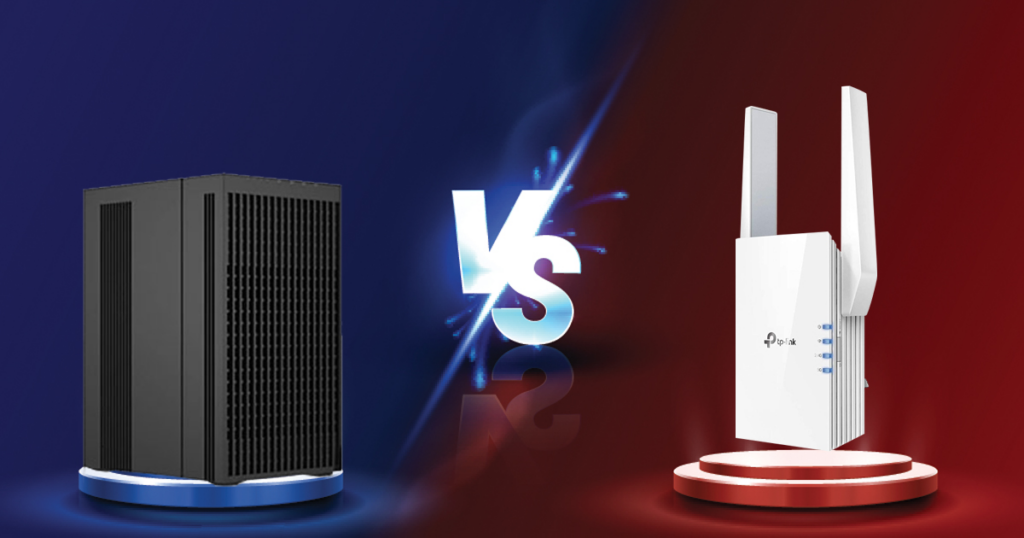
The verdict for 2026 is clear: Mesh routers are the definitive champions for whole-home connectivity. While a Wi-Fi extender like the Linksys RE7310 serves as an effective, low-cost “bandage” for a single problematic room, its inherent architectural flaws—SSID fragmentation and halved bandwidth—make it unsuitable for high-demand modern households. A Mesh system, despite the higher upfront cost, provides a unified, secure, and self-optimizing network “fabric” that supports the professional and recreational demands of 2026. For anyone living in a multi-story home or a property over 1,500 square feet, the investment in a Mesh system like Nest Wifi or Eero 6 is not merely a hardware upgrade, but a foundational requirement for a stable and secure digital future.