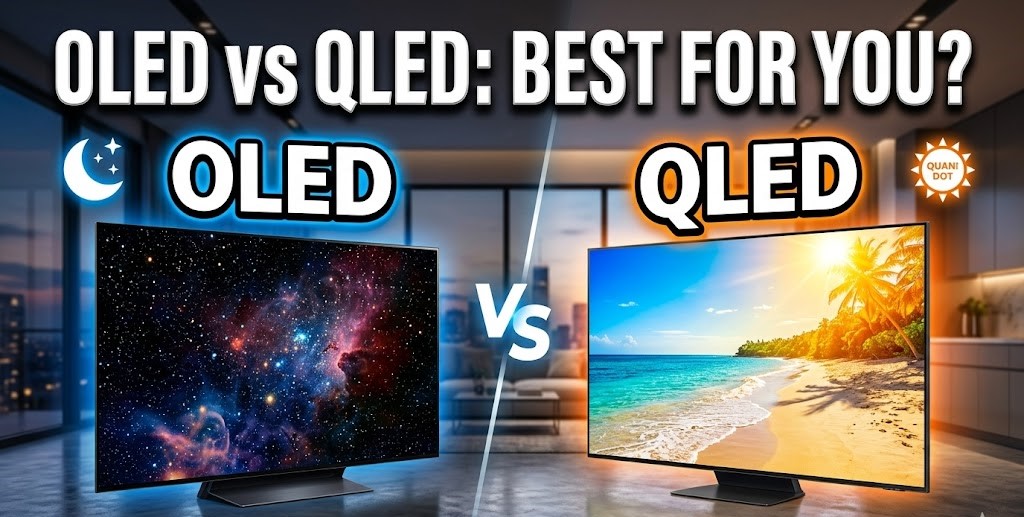
If you are looking for a new television, you have likely come across the terms “OLED” and “QLED”. Both OLED and QLED TVs promise stunning visuals and advanced features, but they cater to very different preferences, viewing environments, and needs.
Here, we take you through the key differences between QLED and OLED TVs, helping you decide which is best for your viewing habits, room setup, and budget.
What are OLED and QLED TVs?
Before diving into the specifics of picture quality and performance, it’s important to understand the fundamental technologies behind these high-end TVs. Both represent the forefront of TV innovation, each with unique strengths.
OLED (Organic Light Emitting Diode)
Each pixel in an OLED display emits its own light, enabling completely true, deep blacks and an infinite contrast ratio. Because they do not require a backlight, OLEDs are renowned for exceptional colour accuracy and exceptionally wide viewing angles, delivering an immersive and natural viewing experience.
QLED (Quantum Dot Light Emitting Diode)
QLED technology uses a quantum dot layer to enhance brightness and colour vibrancy, creating vivid and impactful visuals. Unlike OLED, QLED TVs rely on a traditional LED backlight. While this allows them to achieve incredible peak brightness, it means they produce slightly less precise blacks compared to their OLED counterparts.
Picture Quality Comparison
When it comes to pure picture quality, both OLED and QLED TVs excel in different areas:
- Black Levels and Contrast: * OLED: The self-emissive pixels enable true blacks and unmatched contrast, making it ideal for dark, cinematic scenes.
- QLED: While capable of excellent contrast, QLED TVs may experience slight blooming in high-contrast scenes due to their backlight technology.
- Winner: OLED
- Brightness: * OLED: Limited peak brightness makes OLEDs perfect for dimly lit rooms and home theatres, but less effective in sun-drenched environments.
- QLED: Superior brightness levels make QLED TVs the undisputed champion for well-lit, bright living spaces.
- Winner: QLED
- Colour Accuracy: * OLED: Offers highly natural and accurate colour reproduction for lifelike visuals.
- QLED: Quantum dots heavily enhance colour vibrancy, delivering striking, bold, and heavily saturated hues.
- Winner: Tie (Choose OLED for natural colours; QLED for vibrant tones)
- Viewing Angles: * OLED: Maintains consistent picture quality from nearly any angle, perfect for wide seating arrangements and group viewing.
- QLED: Newer models have improved, but they still lag slightly behind OLED when viewed off-centre.
- Winner: OLED
Performance for Gamers
Gamers have highly specific needs, and both TV types cater to them in different ways:
- Response Time: OLED features lightning-fast pixel response, ensuring ultra-smooth motion and reduced blur during fast-paced action games. QLED is slightly slower but still provides excellent motion handling. (Winner: OLED)
- Input Lag: Both OLED and QLED modern models feature exceptionally low input lag in their dedicated gaming modes, ensuring highly responsive gameplay. (Winner: Tie)
- Burn-in Risks: Static content (like gaming HUDs or news tickers) can theoretically cause screen burn-in on OLEDs over time, although modern advancements have heavily minimised this issue. QLEDs carry absolutely no risk of burn-in, making them the most durable choice for extended, all-day gaming sessions. (Winner: QLED)
Energy Efficiency & Cost
- Energy Consumption: OLED consumes less energy in darker scenes but more in brighter ones. QLED offers more consistent energy use but generally consumes more power overall than OLED. (Winner: OLED)
- Cost Comparison: OLED TVs carry higher initial costs due to their advanced, self-emissive technology. QLEDs offer a much broader price range, making them vastly more accessible to budget-conscious buyers. (Winner: QLED)
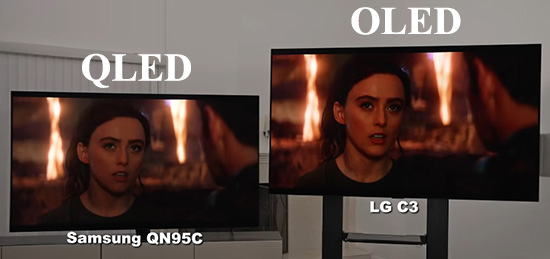
Recommended Models
If you are ready to upgrade your home entertainment system, here are some of the top-tier models currently dominating the market:
Top OLED TVs for a Cinematic Experience
- LG G5 OLED evo 4K HDR Smart TV: Offers near-infinite contrast, perfect blacks, and up to three times brighter visuals than standard OLEDs thanks to its Brightness Booster Ultimate feature. It features HDMI 2.1 on all four ports, making it elite for gamers.
- Sony XR-77A95L 4K BRAVIA XR MASTER Series: Powered by the Cognitive Processor XR, this TV replicates human vision for natural depth. Its Acoustic Surface Audio+ turns the actual screen into a speaker!
Top QLED TVs for Bright Rooms
- Hisense PRO E7 144Hz QLED Smart UHD 4K TV: A massive 75-inch screen with a 144Hz refresh rate, making it an incredible value package for fast-paced gaming. It features Full Array Local Dimming and Dolby Vision IQ.
- Samsung QN70F Neo QLED 4K Vision AI Smart TV: Neo QLEDs provide heavily enhanced brightness and contrast. This model features an intuitive AI smart interface and Auto Low Latency Mode for ultra-responsive gaming.
Summary: Which Should You Choose?
Choosing between OLED and QLED depends entirely on your room environment and primary usage.
If you have a darker room, want the ultimate cinematic picture quality with perfect blacks, or demand the fastest response times for gaming, OLED is the premium choice. However, if you have a bright, sunlit living room, want vibrant colours, have a stricter budget, or regularly play games with static HUDs for hours on end, QLED is the perfect fit.