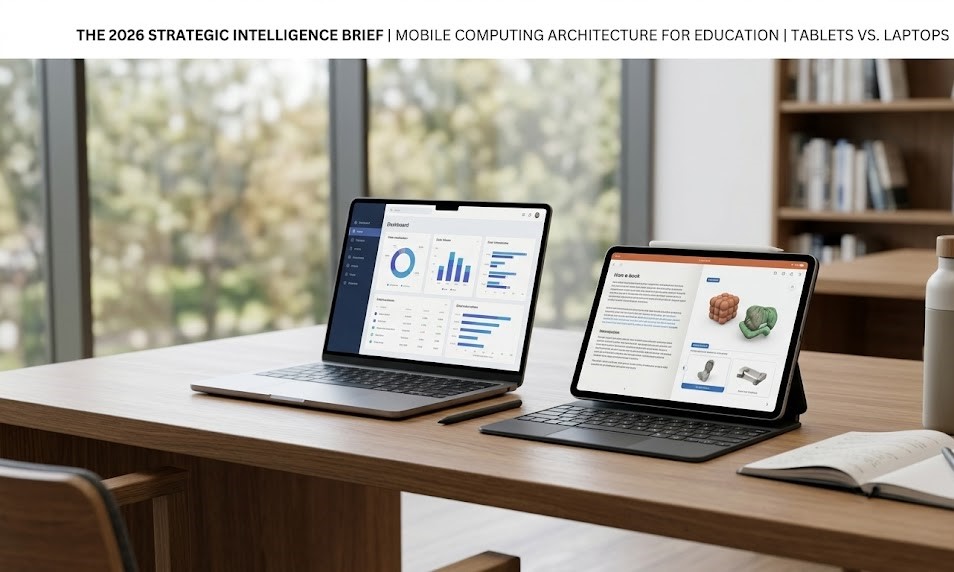
In the educational technology landscape of 2026, the procurement of student hardware has moved far beyond simple brand preference. The fundamental architecture of how students consume, process, and generate information is dictated by their primary computing device. The historical binary choice between a desktop and a Laptop has been disrupted by the exponential evolution of the modern tablet. This intelligence brief deconstructs the hardware mechanics, economic trade-offs, and strategic deployment of tablets versus laptops to optimize academic workflows.

Historical Context and Foundational Evolution
Historically, laptops held a monopoly on academic productivity, while early tablets were largely relegated to media consumption and light web browsing. However, the rise of digital-first curriculums and agile EdTech startups forced a foundational evolution in mobile computing. Tablets underwent rapid hardware maturation, integrating precision styluses, attachable trackpad keyboards, and robust app ecosystems. By 2026, the tablet has transcended its origins as an entertainment screen to become a highly versatile, primary productivity engine capable of threatening the traditional clamshell laptop’s dominance in the classroom.
Technical Mechanics and Hardware Architecture
The operational divide between these two form factors centers on their operating system architecture and physical design.
- The Tablet Architecture: Modern tablets (such as the Tablet computer models running iPadOS or Android) are engineered for ultimate portability and focused interaction. Devices like the 5.3mm-thin IPad Pro weigh under 500 grams, essentially disappearing into a backpack. Mechanically, their operating systems prioritize single-application focus or simple split-screen logic, making them highly intuitive and distraction-free for reading, annotating, and attending virtual lectures.
- The Laptop Architecture: Laptops are engineered for heavy-duty, multi-threaded multitasking. They run full desktop operating systems (Windows/macOS) designed to handle overlapping windows, complex file management, and processor-intensive local rendering (such as compiling code or editing massive video files) that thermal-constrained tablets struggle to execute efficiently.
Economic Impact and Capital Expenditure (CAPEX)
From a microeconomic perspective, the acquisition of student hardware represents a significant household or institutional Capital Expenditure (CAPEX). Tablets traditionally offer a highly efficient entry point. A base-model iPad (starting around Rs 33,990) provides display quality, portability, and battery endurance that budget laptops in the same price tier fundamentally cannot match. However, the economic advantage vanishes at the premium tier. Once a user purchases a high-end tablet (which can scale over Rs 3,00,000) and adds the necessary modular accessories (keyboard cover and digital pen), the total CAPEX often equals or exceeds that of a premium, fully-equipped laptop.
Sociocultural and Behavioral Implications
Behaviorally, the tablet aligns perfectly with the modern student’s need for low-friction, highly mobile learning. The ability to physically detach a screen, walk across a lecture hall, and draw chemical bonds or mathematical equations directly onto a digital canvas mimics the tactile satisfaction of pen and paper, which a traditional laptop keyboard cannot replicate. Socioculturally, for younger demographics (K-12), tablets are perceived as approachable, modular learning companions, whereas laptops are increasingly viewed as rigid, corporate workstations.
Regulatory, Ethical, and Security Frameworks
Deploying hardware to students—particularly minors—requires strict adherence to digital security and screen-time regulations. Tablets inherently operate within “walled garden” ecosystems (like the App Store or Google Play). This closed architecture provides superior defense against malware and allows parents and educational institutions to deploy aggressive, granular parental controls and screen-time limits with much greater ease than the open-directory architecture of a traditional Windows laptop.
Competitive Analysis: The Hybridization of Hardware
In the 2026 hardware matrix, the rigid boundaries between these devices are collapsing, leading to the rise of the 2-in-1 PC.
- Tablets are aggressively attempting to mimic laptops (e.g., the Samsung Galaxy Tab S9 Ultra utilizing Dex mode and keyboard covers).
- Laptops are attempting to mimic tablets (e.g., the Microsoft Surface Pro lineup offering full Windows OS behind a detachable touchscreen). Strategic procurement no longer relies purely on form factor, but on matching the thermal and software limits of the device directly to the student’s academic major. A liberal arts student benefits immensely from a tablet; a computer science major requires the unrestricted compiling power of a laptop.
Predictive Modeling: The Future of Educational Hardware (2026–2030)
Looking toward 2030, predictive models indicate the near-total obsolescence of the “budget laptop” for general education. As ARM-based mobile processors continue to achieve parity with desktop chips, base-model tablets will monopolize the K-12 and standard undergraduate markets. Traditional clamshell laptops will be pushed entirely into the specialized, high-tier professional sectors, reserved strictly for complex engineering, data science, and advanced creative rendering workflows.
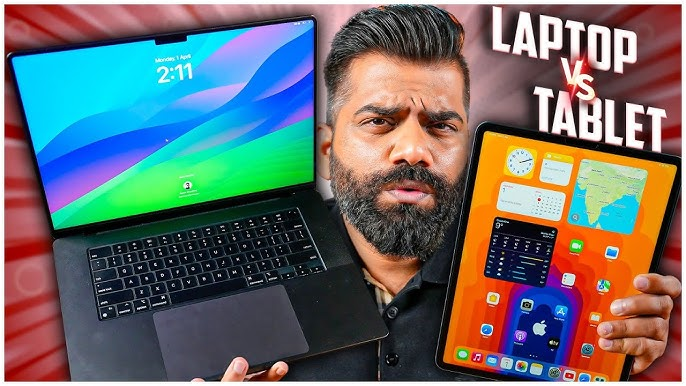
Conclusion
The strategic verdict for the 2026 academic year confirms that the choice between a tablet and a laptop is a calculation of intended workflow rather than sheer computing power. Tablets are the uncontested champions of versatility, portability, and tactile note-taking, offering a distraction-free, highly secure environment that represents the best value for standard academic research and consumption. However, for students requiring unrestricted multitasking, complex software environments, and heavy processing power, the traditional laptop remains an operational necessity. To optimize academic performance, students must rigorously audit their specific syllabus requirements before committing their hardware capital.