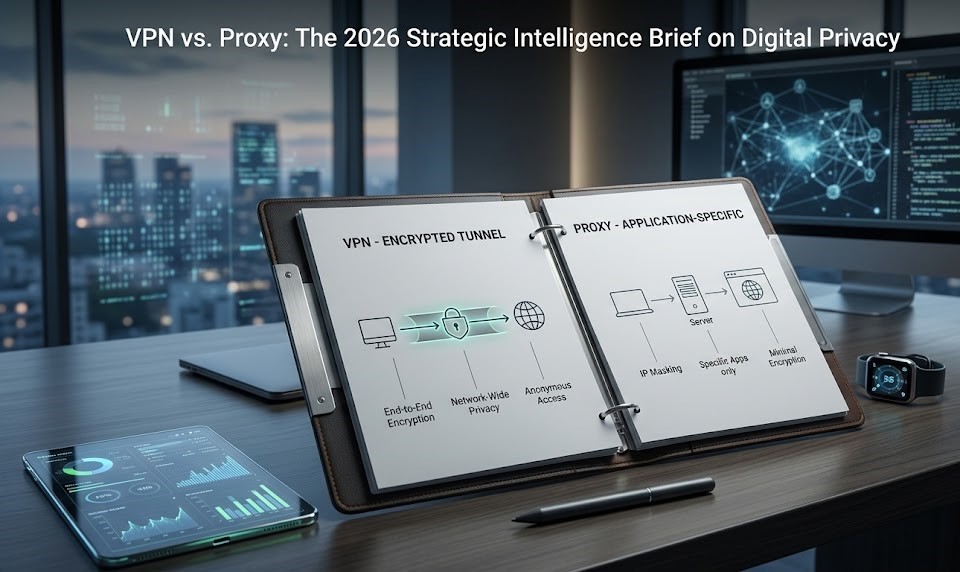
In the hyper-connected landscape of 2026, the distinction between a Virtual Private Network (VPN) and a Proxy server has become a critical focal point for individual and corporate cybersecurity. While both technologies function as intermediaries that mask a user’s IP address, their mechanical execution and security outcomes are fundamentally different. A VPN provides a device-wide, encrypted “tunnel” for all data, whereas a proxy acts as a lightweight, application-specific gateway without encryption. Understanding these nuances is essential for navigating modern threats like ISP throttling, data harvesting, and public Wi-Fi vulnerabilities.

1. Historical Evolution: From Simple Masking to Advanced Encryption
The evolution of these tools reflects the escalating battle between privacy advocates and digital surveillance. Proxies were the early standard, developed in the 1990s primarily to cache web content and bypass basic firewalls. However, as Cyberattacks became more sophisticated in the 2010s and 2020s, the need for end-to-end encryption gave rise to the consumer VPN industry. By 2026, VPNs have integrated advanced Post-quantum cryptography to ensure that data remains secure even against future computational threats. Proxies, meanwhile, have remained largely unchanged in their core function, serving as a specialized tool for speed and basic geo-spoofing rather than comprehensive security.
2. Technical Mechanics: OS-Level vs. Application-Level
The primary structural difference lies in the “Scope of Protection.” A VPN operates at the Operating system (OS) level. Once activated, it intercepts every bit of data leaving the device—from web browsers and background system updates to messaging apps and games—and routes it through an encrypted tunnel. Conversely, a proxy operates at the Application level. It must be manually configured within a specific browser (like Chrome or Firefox) or app. This means if you use a proxy in your browser, your background applications (like Spotify or Windows Update) remain exposed, broadcasting your real IP address and unencrypted data to the open web.
3. The Role of Encryption: AES-256 and Data Integrity
Encryption is the “Great Divide” in this comparison. Most reputable 2026 VPN services, including McAfee Secure VPN, utilize AES-256 bit encryption. This is the same standard used by military and financial institutions; it would take modern supercomputers billions of years to crack. This process transforms your data into a “cipher” (e.g., 9fRseGu4/ridCWOF), making it unreadable to hackers, government surveillance, or your Internet Service Provider (ISP). A proxy server, by contrast, offers zero encryption. It merely replaces your IP address. While a website might think you are in a different country, anyone “eavesdropping” on the connection can still see exactly what you are doing and steal sensitive information like passwords or credit card details.
4. Economic Dynamics: The Hidden Cost of “Free” Proxies
The marketplace for these tools follows the classic “Value Chain” of digital services. VPNs are typically paid subscriptions (averaging $39.99/year for premium services) because maintaining a global network of high-speed, secure servers requires significant capital expenditure. Proxies are often offered for free, but this creates a massive security risk. In 2026, many free proxy servers have been found to engage in “data scraping,” where they monitor and sell user activity to third-party advertisers to monetize their “free” service. As the saying goes in the cybersecurity industry: If you aren’t paying for the product, you are the product.
5. Performance and Speed: Throttling vs. Overhead
There is a common misconception that VPNs always slow down your internet. While the process of encryption does add a slight “overhead” (the time it takes to scramble and descramble data), high-quality 2026 VPNs use protocols like WireGuard to make this delay imperceptible. Furthermore, a VPN can actually increase speeds if your ISP is practicing “bandwidth throttling”—the intentional slowing of your connection when you stream video or play games. By hiding your activity from the ISP, a VPN prevents them from knowing what you are doing, thus bypassing the throttle. Proxies are generally fast because they lack encryption, but they cannot stop ISP throttling because the ISP can still see the nature of your traffic.
6. Regulatory and Ethical Guardrails
In 2026, the use of VPNs is increasingly governed by international data privacy laws like the GDPR. Ethical VPN providers adhere to “No-Logs” policies, meaning they do not store any record of your browsing history. This provides a legal and ethical shield for users in restrictive regimes or those seeking to protect their Digital footprint. Proxies often lack these formal legal protections and are frequently subject to logging, making them a poor choice for anyone concerned with long-term anonymity or legal data protection.
7. Predictive Modeling: The Future of Integrated Privacy (2026–2030)
By 2030, we expect the standalone proxy to become largely obsolete for general consumers, relegated to niche developer tasks. The future belongs to “Unified Threat Management” (UTM) systems, where VPNs are just one component of a larger AI-driven privacy suite. We will likely see the rise of AI-Driven Dynamic Routing, where a VPN automatically switches server locations and encryption strengths in real-time based on the perceived threat level of the network you are using. This evolution will move digital privacy from a “manual toggle” to an “always-on” background utility that is pre-integrated into hardware.
Conclusion
The technical verdict for 2026 is definitive: A VPN is the superior choice for nearly every privacy and security use case. While a proxy server may offer a quick, low-cost way to mask an IP address for simple tasks like bypassing a regional content block, it leaves the user’s actual data completely exposed to interceptors. In an era where data is the world’s most valuable commodity, the lack of encryption in a proxy makes it a dangerous liability for sensitive activity. A high-quality VPN, such as McAfee Secure VPN, provides a multi-layered defense—masking your location, encrypting your device-wide traffic with AES-256, and protecting you from ISP monitoring. For the 2026 user, a VPN is no longer an optional accessory; it is a fundamental requirement for maintaining digital integrity and individual sovereignty on the global web.